HERMES TRISMEGISTUS: The Warning

* (…) wonderful indeed her beauty, but more wonderful her skill in singing, from which art they called her Canens. The fascination of her voice would move the woods and rocks and tame wild beasts, and stay long rivers, and it even detained the wandering bird.

The Tiber saw her last, with grief and toil wearied and lying on his widespread bank. In tears she poured out words with a faint voice, lamenting her sad woe, as when the swan about to die sings a funereal dirge. Melting with grief at last she pined away; her flesh, her bones, her marrow liquified and vanished by degrees as formless air and yet the story lingers near that place, fitly named Canens by old-time Camenae!.’ (Ovid, Metamorphoses, Bk.14, lines 320-440, trans. Golding)

** Come, tell me, where have you proved yourself a seer? Why, when the watchful dog who wove dark song was here, did you say nothing to free the people? Yet the riddle, at least, was not for the first comer to read: there was need of a seer’s help, [395] and you were discovered not to have this art, either from birds, or known from some god. But rather I, Oedipus the ignorant, stopped her, having attained the answer through my wit alone, untaught by birds. (Sophocles, Oedipus Rex, lines 390-395, trans. Storr)

NOTES

LU2 DU given twice (line 1) refers to Ubara Dudu, ruler of Shuruppak and last king before the flood (line 32 of the King List, also seven times in The Instructions of Shuruppak aka The Story of Sukurru) who has two feet incorporated into his name according to the Ashmolean prism version of that text (Lost Stones of the Anunnaki, p.263).  DU.DU, the two feet, together have the dictionary-given meaning ‘sailor’.

An alternative version of this text has two LU2 DI (line 1) and gives the origin of Greek didymus, the ‘twin’. They appear side by side within an unidentified T-shaped word on 4th millennium tablets as indicators of measurement (see here below) and are a good match for the two central pillars of Enclosure D at Göbekli Tepe (Part 5. The Secrets of Man):

AMA, ‘mother’, (line 1) is echoed in the words of the final line (11) with A-MA, her waters as they break to give birth, at the same time causing a great flood. A-MA-RU on this final line correspond to the three words at the end of the antediluvian King List (lines 39 and 40) where they were translated:

Then the flood swept over.

This is Greek Rhea, wife of Kronos and mother of Hestia, Demeter, Hera, Hades, Poseidon, and Zeus. She appears in the incipit of a number of texts as RE-A, ‘gathering of water’ or ‘flood’ (Line 1 of The Story of Sukurru, ca.2600 BC).

Hermes’ warning is encoded in stone (line 2); a reference to the singing sphinx (see quotes above), to the three pyramids of Giza and to other oracular stones.  My translation to ‘reflected’ stems from the first two collocated words, ŠI, the ‘eye’ and ‘first’, with DIB, ‘to pass’, ‘to audit’ or ‘to transfer’. They might equally read: See (the word) transferred (onto stone).

Line 3 reinforces the reference to oracles. Arabic nabi with the meaning ‘prophet’ stems from the phrase BI NA AB BI. The ‘father’s stone’ surrounded by BI can be read either as a plural, as ‘binary’ or as ‘brew’. It or they became known to alchemists as the philosopher’s stone. NA is source of ‘navel’ and, although unorthodox, with BI might thus be read ‘the two navels’ and matched to the two massive stone figures at the centre of Enclosure D at Göbekli Tepe (see below ‘The Twins’). NA is also the stone swallowed and regurgitated by AB, the father of time who is Greek Kronos, in place of the baby Zeus, his third son.

The prophetic nature of the text is confirmed by KA-NI (line 4). With dictionary-given meanings ‘voice’ and ‘thick’ (amongst others), they give the source of Greek canis, the dog. Origin of Ovid’s Canens, they appear on the same line with KAM, the ‘song’, source of the Camenae, prophetic goddesses, mentioned in that same section of Metamorphoses (see quote above). That myth reflected the great antiquity and decline in splendour of the Sphinx of Giza. My understanding from this and other texts is that the original Sphinx, in its low-lying position next to a tributary of the Nile, appeared to make deep growling noises and even to sing when flood waters passed under and around it. There was probably also a fountain pouring from its mouth where the differing sounds announced the rise or fall of the river’s flow; either a light tinkling sound or a deep boom.  The rising of Sirius, the ‘dog star’, coincided with the flooding of the Nile, heralding the new year in Ancient Egypt and causing the Great Lion to roar.

The sphinx was also known to have a voice in the myth of Oedipus and, according to Sophocles (see quote above), it ‘wove dark song’. Greek Oedipus’ name has the meaning ‘swollen foot’. Why was the sphinx so closely linked to feet and to riddles? Line 40 of Maestro of a Lost World provides the answer from under its foot – in the form of a riddle.

Then again, EGER (line 6), pictogram of a walking water, beer or milk jar, is the most obvious source of Egeria who was thought to be one of the Roman Camenae and particularly associated with well water and springs.

Most of the known attributes of Egyptian Thoth and/or Greek Hermes are found in this text:

– god of boundaries and sailors, creator of divisions, messenger (line 1),

– scribe, inventor of writing (line 2)

– psychopomp, musician and trickster (lines 5 and 6),

– secretive (hermetic), ‘spy’ being the dictionary-given meaning of the phrase ŠI-TUM3-LAL (line 7).

– merchant and diplomat, inspector of weights and measures (line 7)

– winged god (line 8)

– god of sailors and psychopomp (line 10).

Hermes is also present in the form of a herma (line 8), the armless and one-legged boundary stone still well attested in later times and usually carved with just a head and phallus. The herma has features in common with certain figures at Göbekli Tepe; the two legless humanoid stone pillars of Enclosure D and also the Urfa man discovered in the same region.  Here below the herma of Siphnos ca. 520 BC:

The ‘wingless’ fate (line 8) might also read ‘birdless’ and calls to mind the dangerous situation of the ithyphallic man sitting on a bird at the bottom of pillar 43 at Göbekli Tepe (see here below).  NAM is the Mesopotamian ‘bird of fate’. The prominent phallus of that carving is also a feature of Pan/Priapus who, like the twins of Gemini, was a talisman of sailors (Part 2. Pagan Wings and Sailors’ Feet).

Hermes is connected to the twins through the later Roman version of the god as Mercury. Line 8 has echoes of the story in which Pollux, son of Zeus, agrees to give away part of his immortality to save his brother Castor.  The twin is a savior. The two central pillars of Enclosure D are discussed in that context in Part 5. The Secrets of Man.

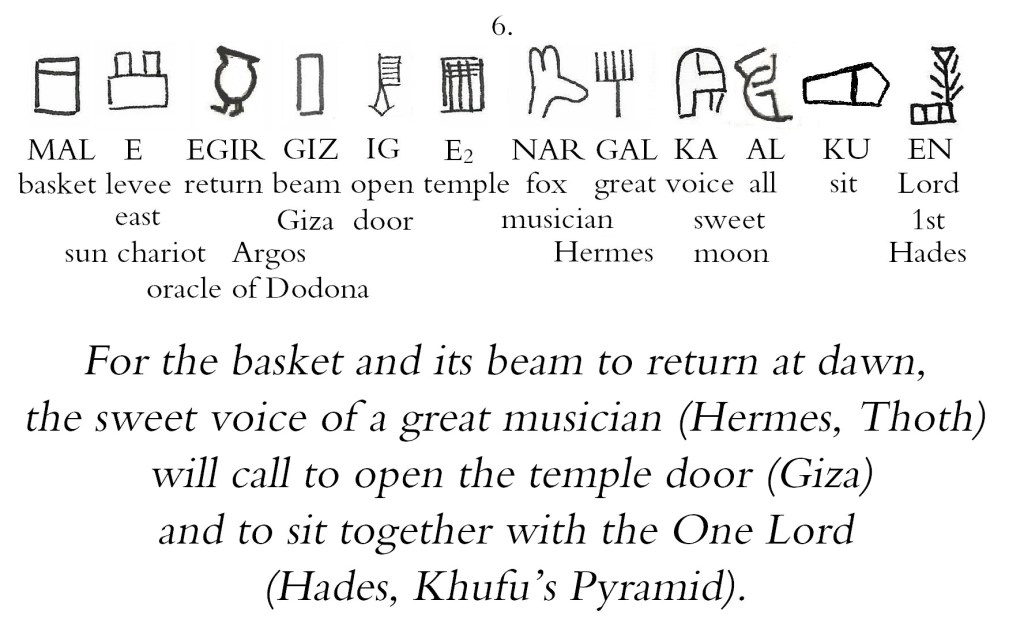
EN, with the dictionary-given meaning ‘lord’ or ‘ruler’, is source of Greek ‘hen’ meaning ‘one’. Threefold repetition of EN (at the end of lines 6, 7 and 8) is a typical linguistic device to indicate an underlying meaning. In this case, they are the three Egypto-Mesopotamian lords who became the three Greek gods, Hades, Poseidon and Zeus, all sons of Kronos, Father of Time, and of Rhea, Queen of Heaven. The eldest of the three brothers is Hades. His temple is the Great Pyramid of Giza. The middle brother is Poseidon and the youngest is Zeus. Together they gave birth to Orion, apparently by urinating into a cowhide. That strange story is reminiscent of another equally bizarre myth involving the regeneration of bees inside the carcass of a bull (Part 3. Land of Milk and Psychedelic Honey).

The person old in his days will not hesitate to ask a child seven days old about the place of life, and he will live. For many who are first will become last, and they will become one and the same. (Gospel of Thomas, Saying n° 4, trans. Patterson and Robinson.)

Kronos swallowed all of his children in the order of their birth with the exception of the last, Zeus, and then disgorged them in the opposite order; the youngest first (Homeric Hymn 5 to Aphrodite). Thus, Poseidon was re-born before his elder brother Hades, a detail perhaps reflected in the words of line 7.  This bears an amusing similarity to the erroneous criticism of Robert Bauval’s Orion correlation theory on the grounds that the three pyramids of Giza could not possibly reflect the positions of the three stars of Orion’s Belt.

In light of the ongoing controversy about the possibility of underground pillars at Giza, it’s interesting to note that the middle pyramid identified as that of Khafre (line 7) is shown by association with Poseidon to be linked to water and the notion of flooding. I noted in Maestro of a Lost World (notes to line 73) that Khafre’s pyramid possesses a Sothic calendar at the northwestern corner of its perimeter and that the rising of Sirius heralded the annual flooding of the Nile. Poseidon was known as Enesidaon, the ‘earth-shaker’ and Themeliouchos, ‘upholding the foundations’ among other epithets. What lies beneath?

The three ENs apply to both the three pyramids below and to the three stars of Orion’s belt above, also known as the Three Magi. The use of this coding to indicate the Giza plateau, pyramids and sphinx, is further justified by Maestro of a Lost World (Enki’s Journey to Nibru), where the reference is found twice, once in a threefold repetition of GIZ, the ‘beam’ or shaft (lines 26-28), and then three E2, the ‘temple’ (lines 56-58) at the beginning of those lines. Here is found the reason for the full title of Meso-Egyptian Hermes Trismegistus, ‘of the Three Great Spirits’. ME has the meaning ‘spirit’. The lion is placed on the second line of both series.

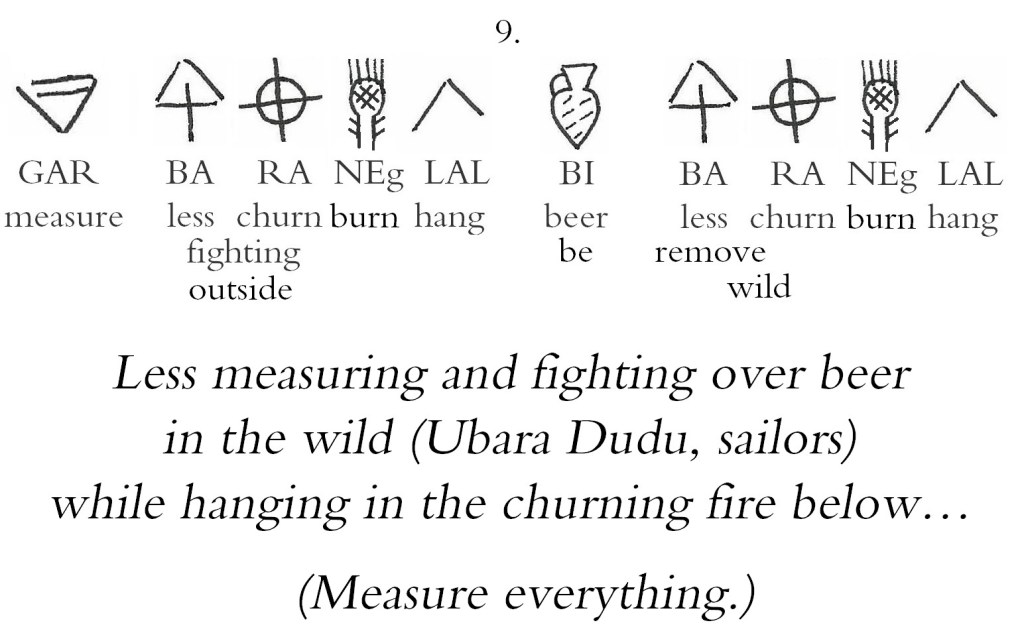
Line 9 is of special interest in that this is the identifying number of Thoth (according to Maestro of a Lost World). Here is found twofold repetition of the four-word phrase BA-RA-NEg-LAL preceded by GAR and with BI as the sixth. Ten words in all. The tenth line of Maestro is a riddle and origin of the ouroboros symbol, the snake biting its own tail. That line also mentions two sailors as DU.DU and DU.DU – four feet in all.

– BA-RA, ‘outside to churn’ is an element of the epithet Ubara Dudu, captain of the original argonauts at the time of the flood. BA-RA can be read as ‘wild’ or ‘fleece’ and is descriptive of an animal such as a wolf or fox. Did Ubara Dudu, sailor at the time of the flood, wear a fox-pelt loin cloth?

– NEg-LAL: taking into account the presence of NEg, a striated version of NE, ‘fire’, and LAL, ‘hanging’, this is most likely an original reference to the Argonauts’ quest to find the golden (fiery) fleece. Potentially, it refers to the prize at the end of some organised fight or battle of skills between men.

– GAR and BI together give the coded message. GAR is ‘measure’ while BI, from its use in the King List, is understood as a plural, a total and the verb ‘to be’ (MU-BI, ‘total years’). GAR-BI in this overall context – and particularly linked to Thoth through the line number – refer to the Giza plateau and translate:

9. All the measures (are here).

On another level, the words of line 9, those of Thoth, are a call to moderation in all things – a warning that went unheeded at the time of a great flood. This also matches the underlying meaning of the first two words of line 3. Translated to ‘cover your skull’, they can also be interpreted as advice:

3. Measure your words.

and appear to refer to the saying of the three monkeys (of unknown source) who see no evil, hear no evil and speak no evil (see UGU in the Interactive Dictionary – pdf).

The man with one foot (line 10) is also identified through pictographic ID or A2, first syllable of the names Alulim and Alalgar, first and second rulers according to lines 3 and 5 of the Sumerian King List (see the breakdown here below). One version of pictographic A2 incorporates IB, the ‘wing’ or ‘arm’, and shows the head as LU, the ‘light’ and ‘lamb’ (see line 10 and another version here below). It has the given meanings ‘time’ and ‘arm’. The ‘foot’ is self-evident. Other versions incorporate NUN, meaning ‘guide’, an element of ‘Anunnaki’. NUN is also read as the name Eridug, first city ruled by Alulim on the translated King List (Lost Stones of the Anunnaki, p.245). So two kings with one foot each, and the second carrying honey-beer:

As is the case elsewhere, this short text incorporates more than one underlying reference to the use of psychedelic substances: According to Carl A. P. Ruck, the Monopods’ cited existence in India refers to the Vedic Aja Ekapad (“Not-born Single-foot”), an epithet for Soma. Since Soma is a botanical deity the single foot would represent the stem of an entheogenic plant or fungus.[12] (Wikipedia)

Interactive Dictionary for Hermes Trismegistus: The Warning

ETCSL 3.3.07 Letter from Ugubi to his mother:

According to the ETCSL, several examples of this text were discovered at Nippur and date to the Old Babylonian period, ca.1900-1600 BC (CDLI ref.P473738).  One version gives the title as “Monkey to its Mother”. The ETCSL translation:

Traveller, traveller, say to my mother what Ugubi says:

Urim is the joyful city of Nanna.

But I sit behind the door of the chief musician’s house in Eridug, the abundant city of Enki.

 Longing consumes me. I don’t want to die because the bread is never fresh and the beer is never fresh. Send a messenger to me at once. It is urgent.

As with other translations of this type, a name – in this case Ugubi – was conjured out of thin air for the purpose of giving a semblance of meaning. UGU is found here (line 3) as U.KA, the original words meaning ‘cover’ and ‘word’ or ‘mouth’ leading to both ‘whisper’ (line 2) and the dictionary-given meaning ‘skull’. UGU4 is another transliterated form of KU (also line 3). The name Ugubi is unattested elsewhere and another version translates the words together as ‘monkey’, providing another possible connection to Thoth who was also depicted in Ancient Egyptian images with the head of a baboon. (see UGU in the Interactive Dictionary – pdf)

This academic translation is comparatively extremely short, its words having been read as syllables in an agglutinative language or ignored altogether, passed off as some nebulous element of grammar – in opposition to my understanding of their largely monosyllabic nature and individual importance. Also, I extend the translations of each word to their maximum, using some more than once.  For example, KASKAL, which has the given meaning ‘crossroad’, can be broken down into KAS, the ‘beer’, and KAL, ‘to be sweet’ (line 10).  All the meanings are relevant here.

On line 4, Urim (or Ur) stems from ŠEŠ.ABg-KI, with given meanings ‘brother’, ‘sea’ and ‘place’. Nanna is another transliteration of ŠEŠ.KI, ‘brother’ and ‘place’. Read with AN (symbol of Egyptian Sheshat) it becomes ‘Brother between sky and earth’. Castor and Pollux again come to mind, but the most obvious identification is Zeus as younger brother of Haides and Poseidon, this epithet referring to his thunderbolt from sky to earth.

Enki results from AN-EN-KI where AN is taken to be a silent prefix indicating a god. In my opinion, as a proper noun and untranslated, it should read either En, the ‘lord’, or Anenki.

Six examples of this text have survived the intervening four thousand years, a fact that indicates its great importance. Here below links to the academic versions: the composite version on the ETCSL (Electronic Text Corpus of Sumerian Literature) website and the original tablets on the CDLI (Cuneiform Digital Library Intitiave) website where they are referenced as P473738, P268979, P269117, P270395, P263564 and P230799:

https://etcsl.orinst.ox.ac.uk/cgi-bin/etcsl.cgi?text=t.3.3.07#

https://cdli.earth/artifacts/473738/reader/88876

https://www.cdli.earth/search/advanced