(72) (…)He turned to his disciples and said to them, “I am not a divider, am I?” (Gospel of Thomas, Nag Hammadi Library, trans. Lambdin) 1
Is it possible that the writing on Sumerian clay tablets when combined with the stones of Göbekli Tepe might provide evidence that the creators of those neolithic sites ca.9600 BC knew of and recorded the astronomical phenomenon of precession? Is it feasible that such foundational knowledge could have been successfully preserved and transmitted over the five or six thousand years separating the earliest known scribes of that region of the world ca.3500 BC from their forefathers?
If the answer to the above is yes, the implication is of course huge – which is why nothing that I have already presented or am writing here should be either taken with a pinch of salt and dismissed out of hand or accepted at face value. Doubt and verify. My translations are almost entirely based in the fundamental meanings that appear in existing lexicons and the individual words can be quite quickly checked through external academic sources such as those listed here in the references.2 The few other gems were found along the way and are all fully explained and justified as are the methods of encoding information in the Sumerian texts. Everything is referenced. I have gone out of my way to always provide the reader with the means to judge for themselves.
Even a superficial study of the retranslation of Enki’s Journey to Nibru – both the original words and their overall layout on the Ashmolean prism (discussed in part two) – provides ample proof that, as far back as 1600 BC, the Sumerians used the rounded number of 25,920 years for their calculations of precession: 12 x 2,160 years during which period the sun rose at the spring equinox in the company of each of the constellations in turn. This apparent backward movement of the sun is observable approximately every 72 years. Thus, it will take 360 x 72 years for the sun to return to its first recorded position. In the same way that the discovery of Göbekli Tepe shows the dating of the earliest signs of civilisation to have been laughably wrong, the retranslation of Enki’s Journey to Nibru shows that our perception of the ancients’ knowledge of the skies has also been way off the mark.
All stones speak in one way or another. At the very least, they tell their stories through the places in which they’re found, by their composition, by the marks made by nature and those carved by man. All masons who come together to create great buildings also speak. How could they work together in harmony without words? How did the architects of Göbekli Tepe explain the floor plan and orientation to people cutting and hauling its stones without some relatively advanced means of communication? Yes, there existed a spoken language in Mesopotamia as far back as the 10th millennium BC. Further still? And what of writing?
It is equally obvious that at least some of the people who lived in the Neolithic sites had fine singing voices and that some danced. They had voices and arms and legs. They had a common language, and music of some kind. The only real questions concern the sophistication of those sounds. Were they orchestrated, accompanied by musical instruments or nothing more than scraps hummed by the masons as the stones were chipped and sculpted and set in place? Were arms raised to the skies at those most ancient sites only for the purpose of fixing the blocks one above the other in some mute and uncoordinated fashion? I don’t think so.
In 2016, I wrote down my first thoughts on this subject. The piece was titled ‘The Rustle of Stones’, borrowed from a strangely haunting phrase written by the Russian author, Aleksandr Solzhenitsyn, and used out of context – may he forgive me – for its evocative beauty:
The stones rustle beneath our feet – we are ascending.
Those recently unearthed traces of a lost culture across southeastern Turkey have thrown the history of humanity into turmoil. Once again, everything we have been told must be entirely revised – not the first time. Perhaps the last.
A small circle of stones now known as enclosure D at Göbekli Tepe surpasses all the others (of the small percentage so far uncovered) in terms of eloquence, most obviously through the series of images across the surfaces of pillar 43. Clearly, the birds were understood as birds. We get the primary message. But placed next to and quite obviously linked to the other forms, the bird gains context. A story forms. Juxtaposed, the images constitute a message of more than one word from a sculptor to an audience. What is a writing system? What is a word? Professional linguists, who invariably prefer them long and horribly obscure, write entire books to answer those questions – uniquely for their peers or students who will be expected to admire the brilliant opacity of it all. I will leave them to it. My preferred scribes were also astronomers, and I doubt they had time to spare for such intellectual itch scratching.
There is one stone artefact that says it – nearly – all. A fragment of a large stone bowl was discovered at the now-submerged site of Nevali Çori in southeastern Turkey and is on display at the Sanliurfa Museum. Here below the image carved some eleven thousand years ago. It’s followed by a quote from an anonymous Greek author. I will leave the reader of this to mull over the link between the two and the implication – if I am right – of their direct connection:

So soon as he had leaped from his mother’s heavenly womb, he lay not long waiting in his holy cradle, but he sprang up and sought the oxen of Apollo. But as he stepped over the threshold of the high-roofed cave, he found a tortoise there and gained endless delight. For it was Hermes who first made the tortoise a singer. (Hymn 4 to Hermes)
The Missing Word
Mentioned in part 1 of this series, there exists a Sumerian word that is an excellent fit for the T-shaped pillars of southeastern Turkey, by the form and in that they both incorporate images across their surfaces. The following are just a few examples that have survived the five-thousand intervening years and found their way into the backrooms of our universities or museums. Below them are the dictionary-given meanings of the words at their centres:
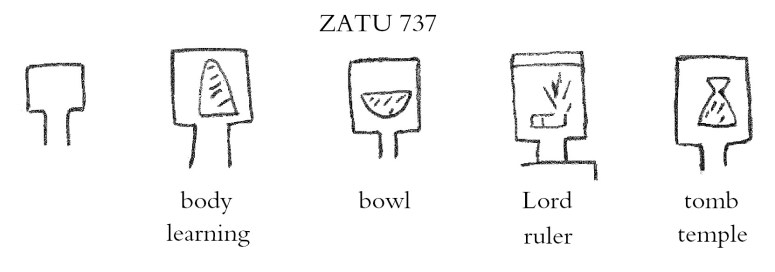
Unfortunately, ZATU737, the outer shell, has not ceded either its meaning or alphabetic equivalence despite its attested presence on numerous 4th millennium tablets, but it can certainly be understood as a container, i.e. other words were inscribed inside it. That is also true of MAL, the ‘basket’ but not the case for two other visually related words: DUB, the ‘tablet’ or UM, the (umbilical) ‘cord’. Nevertheless, it is obvious that these pictographic words all derive from one original founding story and would therefore have had a narrow range of inter-related meanings attached to them at the outset:

The basket is discussed in part 4. Found as a series of three in The Story of Sukurru (ca.2600 BC), they contained the offerings of three categories of people – hunters, carvers and weavers – to a matriarchal figure during a solstice ceremony. Elsewhere, the pictogram can be read as AMA with the meaning ‘mother’ through a combination of MAL with the eight-pointed star AN, the ‘sky’, carried inside it (see my article AMANITA Mon Amour).
At the same time, the basket was a metaphor for the round reed-woven coracle used over millennia to transport goods, animals and people along the Mesopotamian waterways. Navigation was ensured by two sailors pushing it along with long poles: one at the back and one at the front…
The historical importance of that long-neglected word referenced as ZATU737 cannot be overstated. It is worthy of a far more detailed analysis but even a superficial study brings up a recurring list of great interest. ZATU737 with DI at its centre occurs 22 times in the available lists, twice on several tablets. As most of the oldest tablets are badly damaged, it is likely that this twice-repeated composite word was present in a relatively high percentage. In that, it provides extra evidence that this is indeed the same double T-shaped sign appearing on certain ‘pre-writing’ tablets as discussed in part 1:
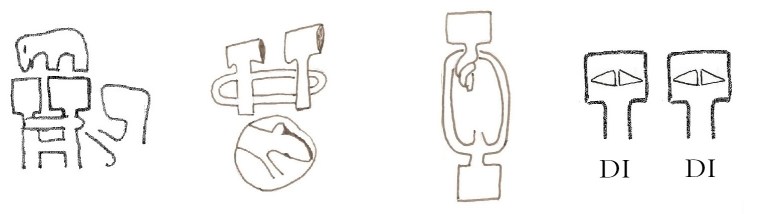
The following five-word phrase is clearly legible on at least two tablets and can be deduced in a number of other damaged texts where some or all of the words containing UD, SAL and/or GAR are still intact.(3) Like the phrase that has become known as ‘Anunnaki’, they are to be read first as individual monosyllabic words:

In the context of the winter or summer solstice and taking the final GAR to be the verb, the phrase might read:
When the sun enters/is in the chamber (womb, cairn), measure the angle twice (compare the two).
This translation is only comprehensible in the context of astronomy: a marking of time at either the winter or summer solstice when the sun rests for three nights in the same position along the horizon. Note that UD, the pictographic sun, sits in third position at the heart of the phrase. Positioning is a key to understanding.
Line 72 of Enki’s Journey to Nibru, as written on the Ashmolean prism, has two five-word phrases with KAK, the triangular nail of measurement, at their centres and a prominent gap between the two. Here below a snapshot of the transcript(4) of that line in the cuneiform script of the 2nd millennium BC:
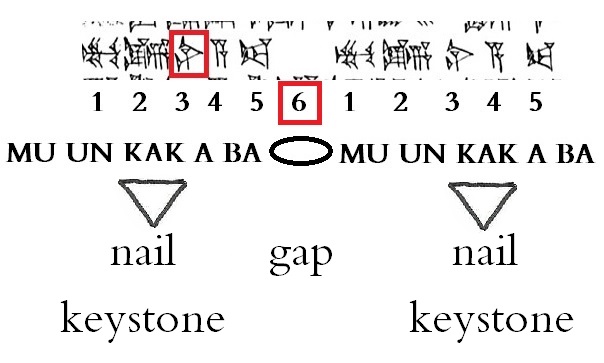
The importance of 72 lies in the approximate number of years necessary to easily perceive and record the smallest movement of the sun against the backdrop of the constellations. It is a precession number. With that context in mind, line 72 reads:
From one age of the world to another to flow, carved on two keystones in the water below.
The two triangles of KAK, the ‘thorns’, ‘pegs’ or ‘nails’, come together to form the Sumerian word DI which has dictionary-given meanings ‘to be equal to’ and ‘to compare’ amongst others. Sumerian DI/DE gives the origin of the first syllable of ‘divide’, ‘divine’ and ‘deity’.
Twin Sailors
For their efficient aid in protecting their fellow Argonauts in the storm that had nearly overwhelmed the Argo, the Gemini were considered by the Greeks, and even more by the Romans, as propitious to mariners, (Allen, Star Names and their Meanings, p.225)

This partial rendering of the two central pillars of Enclosure D as identical is probably not entirely accurate. There are certainly some differences between the two giants. One has an animal jumping out from under its right arm (Discussed in part 3 in the context of an exodus, Apollo, the sun god, is associated with a mouse for unknown reasons.) One has a discreet rendering of a bull inside its belt. They are not exactly the same but identifiable as twins nevertheless thanks to their main common features, the long thin curving arms, the positioning of the hands, the wide belts with their central motif and fox-pelt loin cloths. They face in the same direction. They stand side by side.
Then Thomas called Didymus said to his fellow disciples, “Let us also go, so that we may die with Him.” (John 11:16)
Thomas is referring to the return of Jesus to Jerusalem where it is likely he will be stoned to death by an angry mob. Didymus has the meaning ‘twin’ in Greek while the Latin word discipulus means ‘pupil” and ‘follower’. Both are of unknown origin. It is my contention that they, like many others, stem directly from Sumerian DI. Göbekli Tepe’s Enclosure D was aptly named… there are no coincidences.
Jesus had twelve disciples in all. Everybody knows that. And I’m certainly not the first to point out that the number is a match for the twelve constellations in the path of the sun as it works its way backwards over time. The twins of Gemini, otherwise known as the Dioskouroi, are joint guardians of the northern gate of the Milky Way along with the constellation of Taurus. (The southern gate is kept by Sagittarius and Scorpio.)
Souls were said to descend to earth through the gate of Cancer, a place in the sky close to Castor and Pollux, these being the names given to the twins by the Greeks and Romans.5 Was that two by two? The crab in the sky is home to the Bee Cluster known as Praesepe, also symbolic of rebirth. (See part 3 for the importance of bees in this ancient story.)
According to Greek mythology, Castor and Pollux embarked with Jason, captain of the Argo, on a quest to find the Golden Fleece. The adventures of the Argonauts, some fifty or more celestial and earthly sailors, have survived through more than one written source. But would we recognise any of them if their effigies appeared suddenly out of the ground? The following pieces of this age-old puzzle were gleaned from the important book by Richard Hinckley Allen5 published in 1899:
Mythology insisted that it was built by Glaucus, or by Argos, for Jason, leader of the fifty Argonauts, whose number equalled that of the oars of the ship (…) Egyptian story said that it was the ark that bore Isis and Osiris over the Deluge (…) The Arabians called it Al Safinah, a Ship, (…) The biblical school of course called it Noah’s Ark… (Allen, Star Names and their Meanings, p.65-66)
The Immaculate Clay
In the context of some earth-shattering event, a section of line 97 of Maestro of a Lost World translates:
(…) water and seeds into the immaculate clay of the land from both sides enter.
My understanding of the ‘immaculate clay’ is that it refers not only to the pristine state of the land left behind after the great flood but also to the truthful words written on a celestial clay tablet copied by biblical Enoch. The two original transliterated words read IM-MA and have dictionary-given meanings ‘clay’ or ‘spirit’ with ‘land’. These are also the first two syllables of the name of the rising son ‘Immanuel’ as clearly attested on line 73.
The same collocated words that gave ‘enter’ and ‘seeds’ also appear in The Story of Sukurru (2600-2500 BC) and were translated there:
95. That the place they enter side by side if they agree (…)
The similarity with the story of the animals entering Noah’s ark seems almost too obvious to warrant mention but never mind.
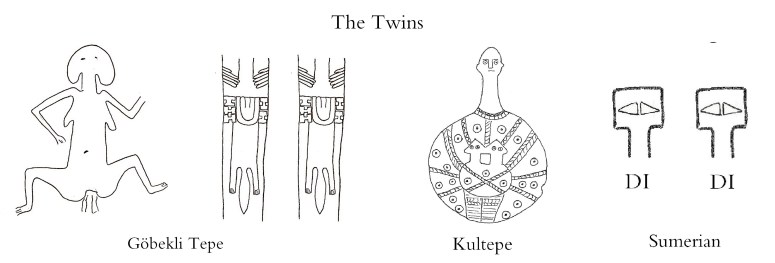
This rendering of the celestial matriarch with her strangely rounded head was crudely scratched onto a stone found at or near the site of Göbekli Tepe. My suggestion is that it shows the two umbilical cords of the twins to whom she has given birth. They can be understood as having two fathers, one earthly and one celestial. That is also the case in the far later story of Castor and Pollux. The half-brothers leave the womb together or rather one after the other, one partially and one entirely born of celestial beings. Another possibility is that the image portrays the concept of birth and rebirth, a departure from and return to the womb. The two ideas are not unrelated. Their cords are intertwined.
A twin-headed single-bodied figure on the clay artefact found at Kültepe (here above) also appears on another closely similar artefact. It was not unique. My first thought was that it represents the two Mesopotamian sailors in their round reed-woven boat. Now I see that this is just one aspect of the original meaning. They are bound with cords to a higher figure, and their pointed heads are the same shape as the caps of Castor and Pollux, said to be the two halves of a single eggshell.
Two bible verses concerning the resurrection of Christ demonstrate the reason for Thomas the Twin’s other epithet. He was known as the ‘doubter’:
Now Thomas called Didymus, one of the Twelve, was not with the disciples when Jesus came. So the other disciples told him, “We have seen the Lord!” “Unless I see the nail marks in His hands and put my finger where the nails were, and put my hand into His side, I will never believe.” (John 20:24-25)
The fingers of the four hands of the two central pillars of enclosure D point towards the navel, place of the maternal umbilical cord and connecting thread to the matriarchal womb in the sky. Is it nothing more than a strange coincidence that the hands of Jesus and of Thomas are prominent elements in that story and are to be understood as taking the same position?
Is it pure coincidence that Jesus is given as the ‘divider’ in the 72nd saying of the Gospel of Thomas, one of the documents hidden in Egyptian caves and rediscovered in 1945? It was most probably considered heretical by those in control of an ancient narrative.
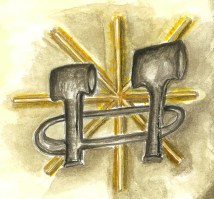
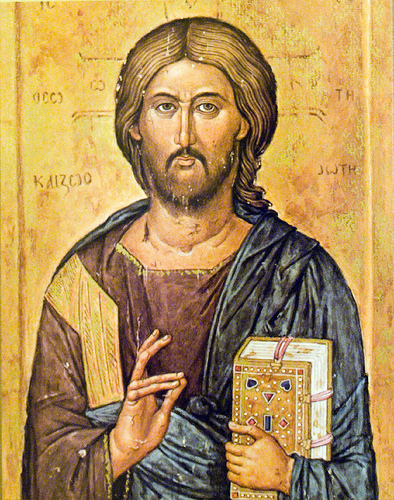
Line 72 of Maestro of a Lost World comprises ten words in all, separated into two groups of five by a gap in sixth position (see the transcription here above), the third and ninth words being KAK, the nails. We all have ten fingers, five on each hand. Placed somewhere between them, we all have a navel – Latin umbilicus, Greek omphalos – the enduring knot showing our connection to a life-giving cord. The cover image here is known as Christ Pantocrator,6 the Almighty, the Great Judge. What is it that He signals?
Everyone has the right to doubt – even when a pair of extremely ancient stone giants have already silently challenged everything we think we know about the past.
Adam, the Man
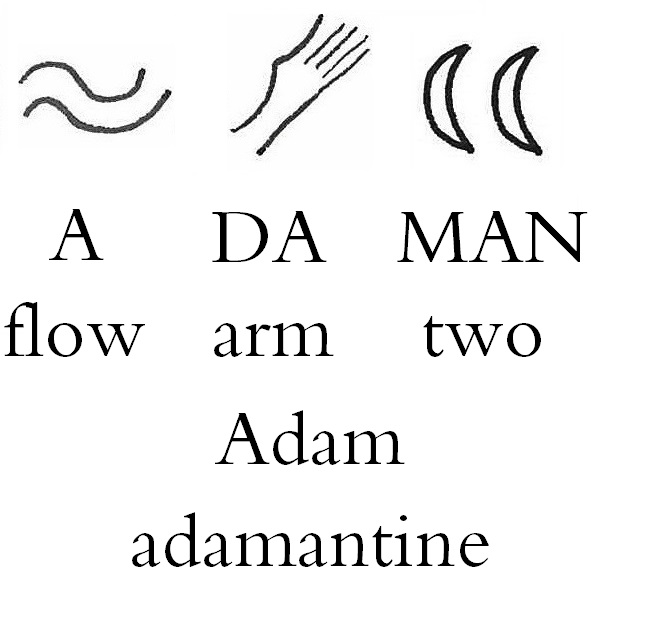
This three-word phrase appears on line 112 of Maestro of a Lost World and is also present in numerous other texts. It’s easily understood as the flow or movement of two arms or, in context, two stone pillars. It can also be read, again according to context, as the two banks of a river.
These are the words that gave the far later biblical name Adam and also ‘adamantine’, the ‘unbreakable’ and ‘unalterable’ through Greek adamas. Why is this most ancient and obvious source of such a famous name not recognised as such? Is it because academics insist on transliterating them as A-DA-MIN3? And yet MAN and MIN3 are two alphabetic renderings of the same original word. When and why was that choice made? Some obscure and indisputable grammar rule established in recent times?
Then, if it is accepted that transliterated Sumerian MAN is source of ‘man’, yet another word of unknown origin, the inherent duality of it will need explaining. Is this an indication of a celestial origin, the creation of man through the mixing of seed with that of an otherworldly race? Was Zechariah Sitchin right when he made that seemingly outlandish claim? Did he get that part of the story right despite his otherwise grotesquely contrived interpretations of the Sumerian pictograms? Or do the words on clay coupled with the carvings of neolithic sites more simply indicate the existence of a highly knowledgeable and spiritual people capable of sophisticated calculations of time and space, survivors of a lost pre-diluvian civilisation? Or is this all just unproven fantasy? Is everything written here merely a modern fabrication artificially placed over an ancient and isolated language? Doubt and verify.
Enclosure D at Göbekli Tepe leads us to the edge of a giant rabbit hole. The meaning of it all has been fragmented and scattered about during the thousands of years that separate us from the sculptor of those images. But we have also been handed a tangled bunch of missing keys and can begin trying them one by one in ancient doors.
It will take time and patience to sift through them all. In the meanwhile, and for those who are interested in learning more about the extremely ancient links between Mesopotamia, Egypt and Greece, my latest translation titled Hermes Trismegistus: the Warning is posted here:
References
1 Number 72 of the 114 secret sayings of Jesus according to the Lost Gospel of Thomas, part of the Nag Hammadi Library discovered in 1945 in the Egyptian desert:
A man said to him, “Tell my brothers to divide my father’s possessions with me.” He said to him, “O man, who has made me a divider?” He turned to his disciples and said to them, “I am not a divider, am I?”
http://www.gnosis.org/naghamm/nhl_thomas.htm
2 See the ePSD (Electronic Pennsylvania Sumerian Dictionary) website here: http://psd.museum.upenn.edu/nepsd-frame.html
See the CDLI (Cuneiform Digital Library Initiative) search page here:
https://cdli.earth/search/advanced
3 A few CDLI references for tablets containing elements of this phrase ca.3200-3000 BC: P000051, P000087, P000165, P000237, P000247, P464118
4 CDLI ref. P368427. The academic translation of line 72 reads “As it has been built, as it has been built”.
5https://archive.org/details/starnamesandthe00allegoog/page/136/mode/2up?view=theater&q=gate
 Signs of the Sumerians